Lockout/Tagout (LOTO) is a required safety process used to control hazardous energy during servicing, maintenance, repair, cleaning, and inspection of machines and equipment. In compliance with Cal/OSHA Title 8, Section 3314, LOTO helps prevent the unexpected startup or release of stored energy that could cause serious injury.
At UCSB, LOTO is implemented through a locally managed program supported by Environmental Health & Safety (EH&S). Departments and their supervisors are responsible for identifying equipment that requires LOTO, developing and maintaining equipment-specific procedures, and ensuring employees are trained and authorized to work on and/or near equipment that requires LOTO or stored energy that could cause injuries. EH&S provides oversight, technical guidance, training standards and resources, and program support.
This page outlines roles and responsibilities for the UCSB LOTO Program and links to detailed procedural guidance and resources.
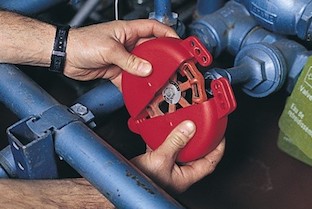
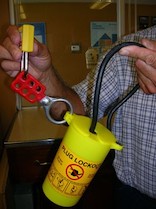
Lock-out consists of placing a disconnect switch, breaker, valve, spring, pneumatic assembly, or other energy-isolating mechanism in the off or safe position. A device is placed over, around, or through the energy-isolating mechanism to lock it in the off or safe position, and only the person attaching it applies a removable lock to the apparatus.
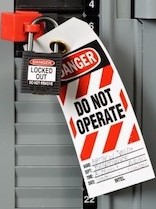
Tag-out is the process by which an energy-isolating device used for lockout is placed in the off or safe position and a written warning is attached to the device or placed in the area immediately adjacent to the device. The tag must identify the person who applied it and be durable and able to withstand the environment in which it is placed. The tag must be substantial so that it can be attached to a variety of locations and will not come off. A tagout device will be used only when the energy-isolating device is not capable of being locked out. The required means of attachment for a tagout device is a self-locking, non-reusable, nylon cable-type tie that is capable of withstanding a 50-lb. force.
Lock-out/Tag-out Devices such as key or combination locks are used to hold the energy isolation device in a safe position for the duration of the job. Locks are required to be standardized in color, shape or size. The industry best practice for lock-out/tag-out is all red locks and devices; however, in some facilities, the use of different colored locks may be beneficial for distinguishing between trades. Furthermore, locks must be substantial enough to prevent removal without the use of excessive force and tags must be substantial enough to prevent inadvertent or accidental removal (generally affixed with an all-weather nylon cable tie). These locks and tags must also clearly identify the employee applying and using the device. Tag-out devices, which include a prominent warning tag and means of attachment, are also required to be used in conjunction with lockout devices.
The UC Santa Barbara Energy Isolation - Lock-out/Tag-out (EI-LOTO) Program requires campus, field station personnel and contractors to implement safe procedures when working on UCSB equipment or utility systems with one or more energy sources. Because of the potential for injury from energy sources that operate equipment / utility systems, this program guides safe installation, set-up, adjustment and maintenance work on equipment by isolating energy sources prior to commencing work. The program is required by Cal/OSHA safety regulations.
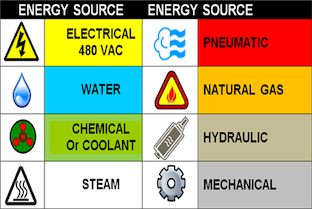
This EI-LOTO Program is applied to ALL forms of potentially hazardous energy and is applied to every individual piece of equipment that has potentially hazardous energy. The types of energy needing to be isolated include the potential energy (mechanical springs in tension or compression, compressed gas cylinders, counter weights, etc.), kinetic energy (rotating flywheel, moving parts, rolling components, parked vehicles, etc.) and utility energy (electricity, compressed air, steam, domestic water, etc.) that may be part of a particular machine or utility system. Such equipment may include building mechanical systems such as HVAC and air handlers, some larger experimental equipment that is hard wired or plumbed to building utility systems such as a Scanning Electron Microscope, an air compressor, a printing press, some shop equipment such as a programmable milling machine, CNC equipment, wood-working equipment, powered cranes and other lift equipment, etc. It may even apply to equipment that can be ‘unplugged’ but may have energy potentially stored in the ‘unplugged’ equipment.
This program is applied prior to working on all types of equipment powered by one or more energy sources, or whenever an equipment guard is removed or safety interlock is bypassed, or whenever a person must place any part of their body into potentially-operating equipment.
This program does NOT apply to:
- Minor tool changes, adjustments, and other small service activities that take place during normal operations if they are routine, repetitive, and integral to the use of the equipment. (Example: Changing a drill bit on a drill press.)
- Equipment that is isolated and made safe by simply unplugging an electrical cord, compressed air hose, or some other single-source energy supply when the person working on the equipment has exclusive control over the connection to the energy source.
“Live Work” or “Hot Work” on equipment that cannot be shut down and locked-out / tagged-out is allowed by the program provided that:
- Department management demonstrates that continuity of service is essential, and
- Shutdown of the system is impractical, and
- Special equipment is provided along with specific standard operating procedures that are documented and followed that will provide effective protection for personnel. (Example: Work on certain life-sustaining equipment or utility lines.)
All three of the above criteria must be met before “Hot Work” is permitted by law. If they cannot be met, then EI-LOTO must be practiced. If the above criterion can be demonstrated by management, prior to conducting “Hot Work” contact EH&S Safety Engineering to review safe work procedures in order to assist in developing adequate safeguards and “Hot Work” processes.
Roles and Responsibilities
This program is implemented at the department level, with responsibilities shared among department management, supervisors, authorized and affected employees, and Environmental Health & Safety (EH&S). EH&S provides program standards, training guidance, and technical consultation, while departments are responsible for day-to-day implementation and compliance with Lockout/Tagout (LOTO) requirements.
This webpage defines departmental roles and responsibilities for implementing Lockout/Tagout (LOTO) at UCSB. It does not establish procedural requirements or training criteria. Detailed requirements for hazardous energy control are addressed in the UC Shop Safety Manual – Section 7 and the UCSB Addendum to Section 7.
The resources linked below are provided to support departmental implementation. Use of sample forms or records is optional, and equivalent documentation appropriate to the complexity and risk of the equipment involved is acceptable. Completion of LOTO documentation does not constitute training, qualification, or authorization.
Owner Departments that own, operate, or maintain industrial shop equipment must:
- Designate department Lockout/Tagout Responsible Persons (RPs).
- Ensure LOTO RPs and supervisors receive required LOTO training.
- Identify equipment and systems that require LOTO due to hazardous energy.
- Ensure equipment-specific LOTO procedures are developed, documented, and maintained when required.
- Ensure equipment modifications or changes are evaluated for LOTO impacts.
- Provide and maintain approved LOTO devices (locks, tags, hasps, and hardware).
- Ensure departmental records for LOTO procedures, training, and audits are maintained.
Department-designated LOTO RPs and supervisors must:
- Implement and administer the departmental LOTO program.
- Maintain an inventory or listing of equipment requiring LOTO procedures.
- Ensure equipment-specific LOTO procedures are current and accessible to employees.
- Ensure authorized employees complete documented equipment-specific LOTO training and are formally authorized to conduct LOTO for equipment that they have proof of documented training for.
- Verify LOTO is used when required for servicing, maintenance, cleaning, and repair tasks.
- Ensure affected employees are notified when LOTO is applied or removed.
- Remove unsafe or non-compliant equipment from service until hazards are corrected.
- Monitor LOTO practices and correct unsafe behaviors.
- Communicate and enforce stop-work authority when hazardous energy control is inadequate.
- Participate in audits, inspections, and corrective actions related to LOTO.
- Coordinate with EH&S for technical support, alternative methods, or complex LOTO scenarios.
Authorized employees are those trained and approved to perform LOTO. Authorized employees must:
- Follow established, equipment-specific LOTO procedures.
- Apply personal locks and tags to all required energy-isolating devices.
- Verify a zero-energy state prior to beginning work.
- Ensure locks and tags clearly identify the individual performing the work.
- Maintain control of their keys at all times.
- Remove only their own locks and tags, except under approved emergency removal procedures.
- Stop work and notify supervision if unexpected energy sources or hazards are identified.
Affected employees are those who operate or work near equipment subject to LOTO. Affected employees must:
- Recognize and respect LOTO devices and procedures.
- Never attempt to start, operate, or energize locked or tagged equipment.
- Follow supervisor instructions related to equipment shutdowns and restarts.
The UCSB Office of Environmental Health & Safety (EH&S) will:
- Maintain and update the campus Lockout/Tagout Program to ensure it meets or exceeds regulatory requirements.
- Establish minimum program requirements, guidance, and standards.
- Provide LOTO training content, authorization criteria, and refresher guidance.
- Assist departments with hazard assessments and development of LOTO procedures.
- Support departments in evaluating alternative methods when traditional LOTO cannot be applied.
- Conduct program reviews, inspections, and audits as part of shop safety and compliance activities.
- Provide technical consultation and regulatory interpretation.
Contractors performing work on campus must:
- Comply with applicable Cal/OSHA and UCSB LOTO requirements.
- Coordinate LOTO activities with the owner department prior to starting work.
- Ensure their employees are trained and authorized under their employer’s LOTO program.
- Resolve any conflicts between contractor and campus LOTO procedures with the owner department and EH&S before work begins.
Departments should refer to the campus LOTO Program Links and the UC Shop Safety Manual for detailed procedural requirements, examples, and training resources. For assistance with developing or revising LOTO procedures, contact EH&S
For further information please contact the EH&S Industrial Safety Program at ehs-industrialsafety@ucsb.edu.